

Documenting the Infusion
Below the formulation, the IV Therapy section records the infusion itself, in the order it happens: how you gave the IV, the patient’s vital signs while it ran, and how it ended. Each item is a set of choices; click the one that applies, and it is highlighted. Every answer is written out as a sentence when the chart is printed or appears in the patient’s history.
How the IV Was Given
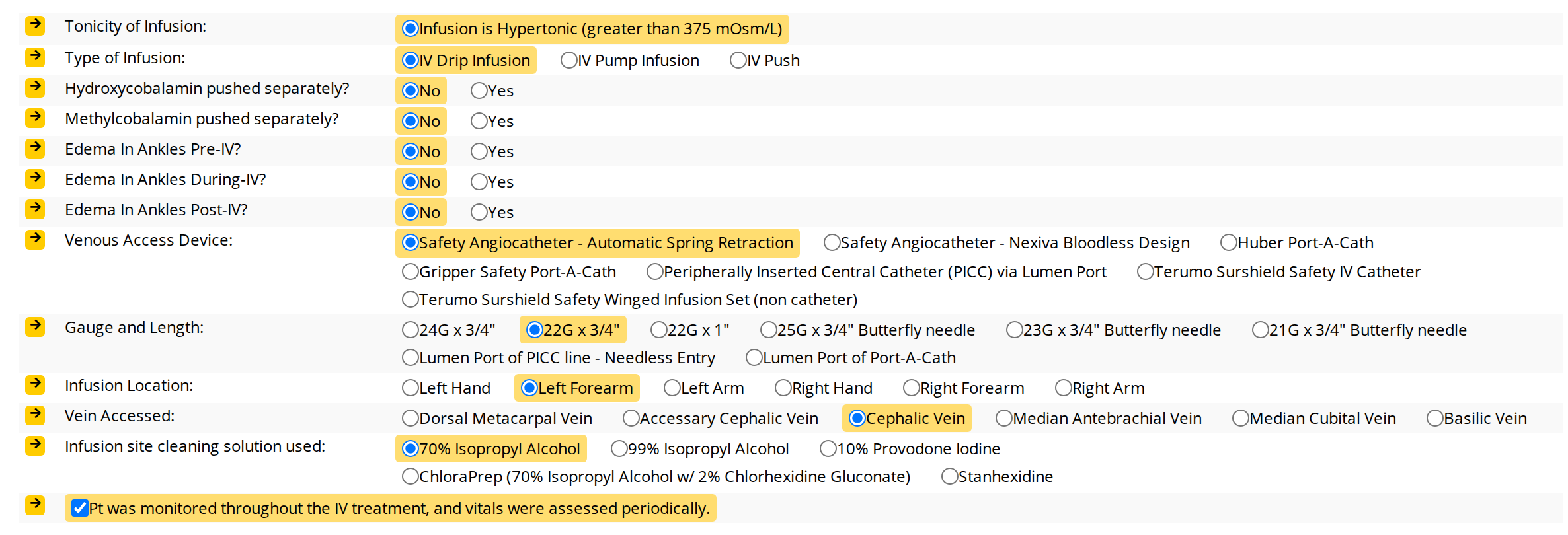
The procedure questions, with the choice for each highlighted.
| Question | Choices |
|---|---|
| Tonicity of Infusion: | Infusion is Hypertonic (greater than 375 mOsm/L). Choose it when the Final Osmolarity above is more than 375; OutSmart does not choose it for you. |
| Type of Infusion: | IV Drip Infusion, IV Pump Infusion or IV Push |
| Hydroxycobalamin pushed separately? | No or Yes |
| Methylcobalamin pushed separately? | No or Yes |
| Edema In Ankles Pre-IV? | No or Yes |
| Edema In Ankles During-IV? | No or Yes |
| Edema In Ankles Post-IV? | No or Yes |
| Venous Access Device: | Safety Angiocatheter - Automatic Spring Retraction, Safety Angiocatheter - Nexiva Bloodless Design, Huber Port-A-Cath, Gripper Safety Port-A-Cath, Peripherally Inserted Central Catheter (PICC) via Lumen Port, Terumo Surshield Safety IV Catheter or Terumo Surshield Safety Winged Infusion Set (non catheter) |
| Gauge and Length: | 24G x 3/4”, 22G x 3/4”, 22G x 1”, the 25G, 23G and 21G x 3/4” Butterfly needle, Lumen Port of PICC line - Needless Entry or Lumen Port of Port-A-Cath |
| Infusion Location: | Left Hand, Left Forearm, Left Arm, Right Hand, Right Forearm or Right Arm |
| Vein Accessed: | Dorsal Metacarpal Vein, Accessary Cephalic Vein, Cephalic Vein, Median Antebrachial Vein, Median Cubital Vein or Basilic Vein |
| Infusion site cleaning solution used: | 70% Isopropyl Alcohol, 99% Isopropyl Alcohol, 10% Provodone Iodine, ChloraPrep (70% Isopropyl Alcohol w/ 2% Chlorhexidine Gluconate) or Stanhexidine |
Check Pt was monitored throughout the IV treatment, and vitals were assessed periodically. when that applies.
Vital Signs
The Vital Signs table records the patient’s vital signs at each check during the infusion. Add a row each time you take them.
- Click +Add Interval, under the table. A new row appears with Time set to the time right now.
- Fill in Blood Pressure (mmHg), Pulse (b/min), Respiration (r/min), Temperature (°C) and % Saturation (SpO2).
- Check Drip Rate (mL/min). It is filled in from the row before, or from the drops per mL for the first row, so change it to the rate you set.
The minus button at the start of a row removes it. Clear All, above the table, removes every row after asking Clear All Vitals Measurements?; click Yes, Delete Vitals to go ahead.
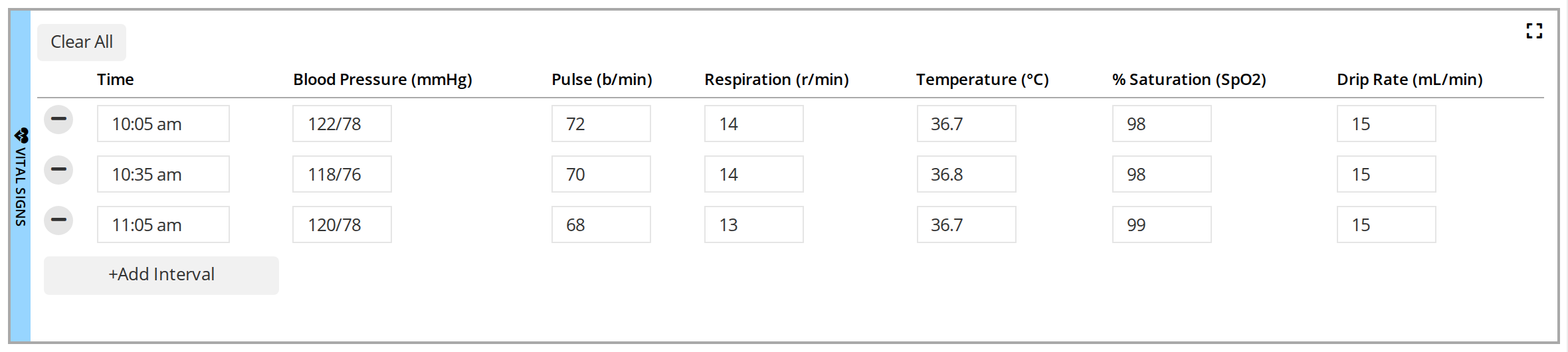
Three checks, half an hour apart. +Add Interval adds a row for the next one.
How the IV Ended
| Question | Choices |
|---|---|
| Catheter flushed before removal? | Yes, post IV flush with 5ml of 0.9% NaCl posiflush XS (10 ml syringe) to clear catheter of IV fluid (only for people without implanted PICC/Port-A-Cath), or No, see SAS or SASH technique below |
| Catheter / Needle Status on Removal: | Catheter: Normal and Intact, Catheter: Broken, Severed, Needle: Normal and Intact, Needle: Broken, Severed, Access Was Through PICC Line, no damage or Access Was Through Port-A-Cath, no damage |
| Did any of the following occur during treatment? | Check No, there were no complications during treatment, or check each complication that occurred, from Hematoma and Allergic Reaction to Infiltration, Extravasation, Phlebitis and Syncope. You can check more than one. |
| Status of patient post-treatment? | Check Patient Tolerated Treatment Well, Was Stable on Discharge post 15 minutes after stop of IV Infusion and Patient Has Received Post Infusion Instructions, as they apply |
| Was there a pre & post flush procedure on a special device carried out? | No, not required as patient did not have a PICC line or Port-A-Cath implanted., or the SAS or SASH technique, each described in full |
Additional IV Therapy Notes
The last box in the section, Additional IV Therapy Notes:, is for anything else about the IV: how the patient felt, what you advised, when the next IV is due. MANAGE SMARTLIST opens your SmartList for wording you use often. The notes print under Additional Notes.
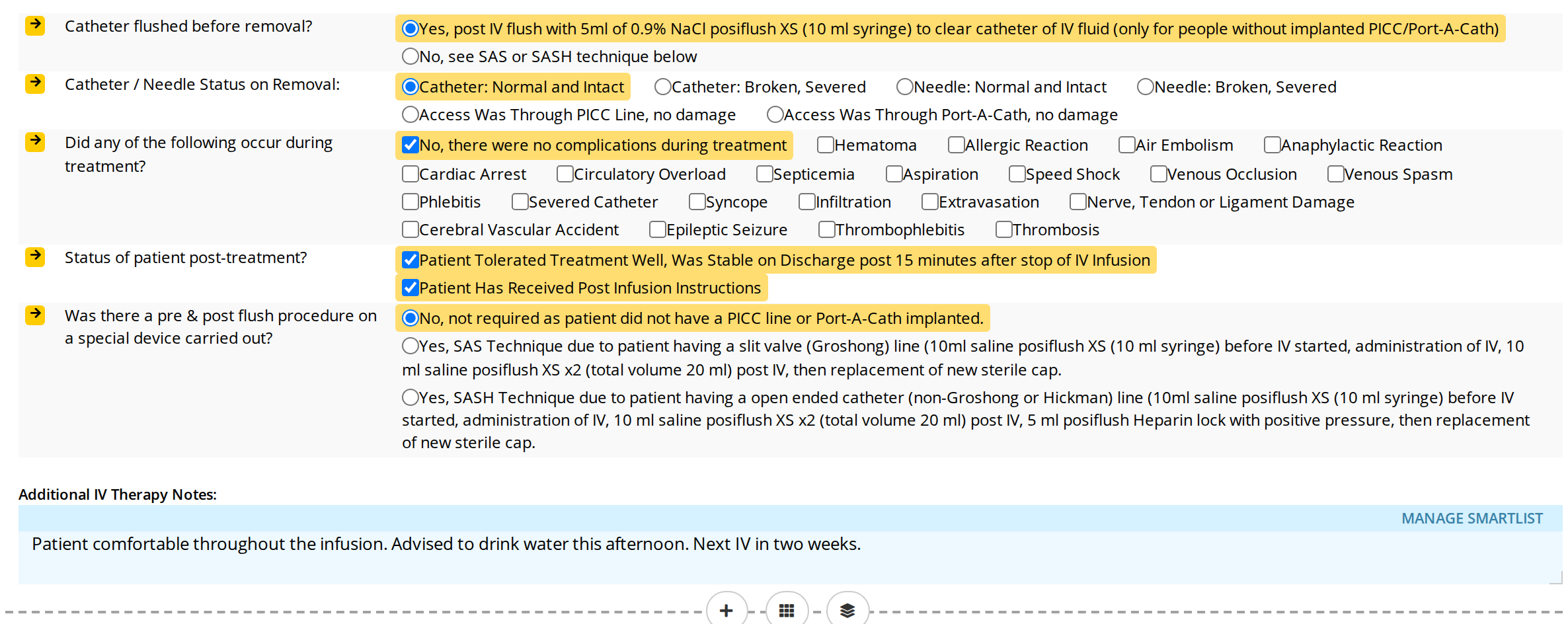
The end of the IV: removal, complications, the patient's status and the notes.
What a Protocol Keeps
A protocol saves the tonicity, type of infusion, cobalamin answers, venous access device, gauge, location, vein, cleaning solution, both flush questions and the notes, so an IV you give the same way each time is filled in already. The edema questions, monitoring box, catheter status, complications, patient status and vital signs are recorded fresh for each visit. See IV Protocols and Recipes.
Related Pages
- IV Therapy: adding the section and how it is laid out
- Pre-IV Screening and Infusion Timing: the questions before the IV
- Building the IV Formulation: the final osmolarity that decides the tonicity